Stainless for smart contracts
Stainless fork aimed at smart contracts
Stainless is a tool for verifying Scala programs developed by the LARA. This fork can perform verification of Smart Contracts.
- Presentation
- Demo
- C4DT work
- Technical
Introduction
Stainless is a tool to help designing highly reliable programs in Scala. Using Formal Verification, it will check whether the system behaves according to how it was specified, or if it will deviate in unexpected ways. Logical errors, security vulnerabilities and other defects can therefore be detected before the program is deployed.
More precisely, Formal Verification is a technique that uses mathematical logic and automated reasoning to produce proofs, similarly to how a mathematician proves a theorem by using axioms and rules of deduction. The result of this process can:
- prove that a program behaves always correctly, no matter what inputs it receives;
- prove that a program will always reach termination, without the possibility of remaining stuck in an infinite loop;
- on the other hand, pinpoint precise sets of inputs which will cause the program to behave incorrectly.
Formal Verification vs. Testing
Formal Verification differs from more commonly used approaches for testing in several ways. The latter usually involves selecting a set of inputs and checking that the program produces the expected output. We can be smart and carefully choose the checked inputs, making sure that corner cases are included, but in the end the number of verified scenarios will still be a very small subset of the complete possibilities. Using this approach, it is possible to prove that a program is incorrect (when one of the tests fails), but it is impossible to prove that no defect exists.
In contrast, Formal Verification is more complex to use, and due to its mathematical nature may require some background with logic and proof building. However, when successfully used, it covers all cases and completely guarantees the absence of defects.
One way to illustrate the difference is as follows. Imagine that you are producing an image and want to make sure it is correct. By testing, you will check a few pixels, perhaps a border or a corner, and verify that they are correct: 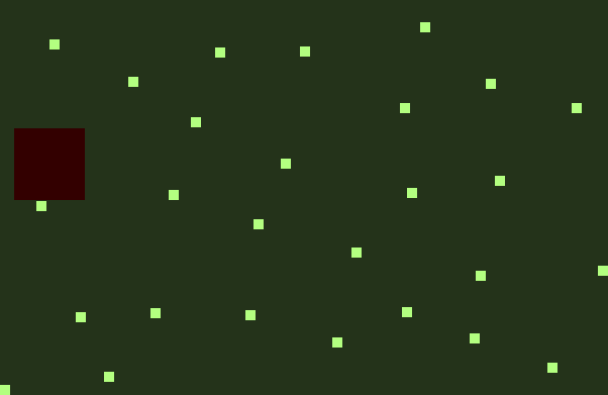
This will give you some assurance, but you will never be completely sure, unless you try each and every one of the pixels, which can be very long, if not impossible in a reasonable amount of time depending on the size of the image.
Now by using mathematical logic, you can either construct a proof that your image is correct no matter its size: 
Or, failing that, you can directly obtain an image location that is incorrect: 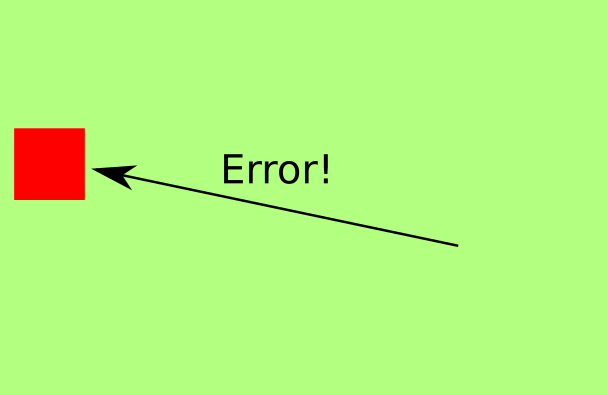
Smart Contracts
Smart Contracts are computer programs that are executed on a blockchain. They usually enforce mechanisms or model real-life processes, such as e-voting, insurance or loans, with the advantage that they do not require centralized trust.
Smart Contracts typically involve the transfer of assets such as money. It is therefore critical that they are devoid of errors, as mistakes will translate in possibly significant financial loss. Their source code is also generally short compared to applications, which helps in keeping the complexity of applying Formal Verification manageable. A variant of Stainless exists that can verify Smart Contracts written for the popular Ethereum blockchain.
OmniLedger, another project curated by the C4DT, is a blockchain implementation developed at the DEDIS lab. It also contains a layer allowing it to run an Ethereum virtual machine. Together with Stainless, they provide a complete platform for the development and execution of verified Smart Contracts, as illustrated in the following diagram: 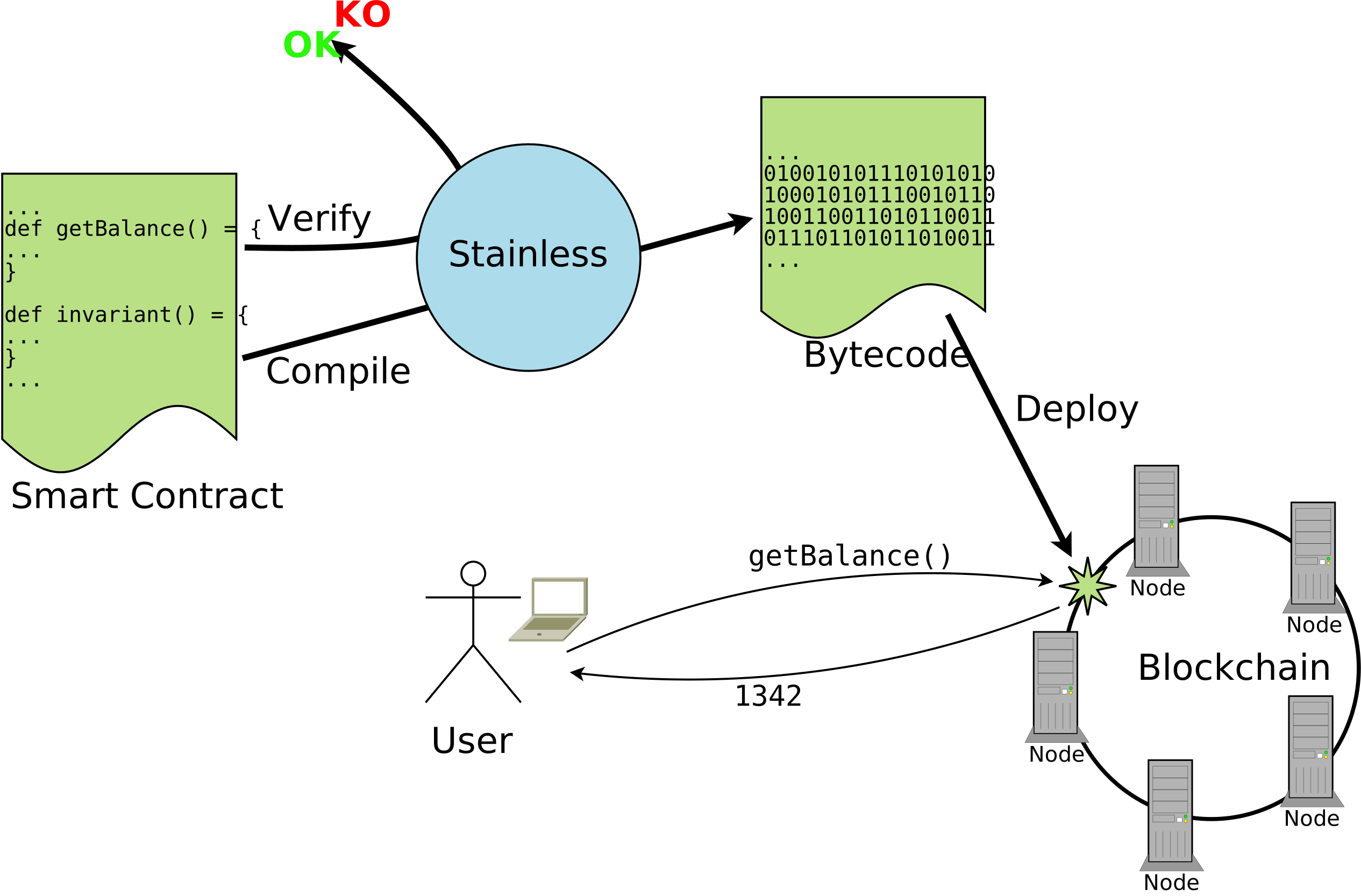
The Smart Contract author uses Stainless to determine whether the code fulfills its specifications, iterating until no error is found. At this point, he uses Stainless to compile the Smart Contract, making it ready to be deployed on the blockchain. Each deployment creates a new instance of the contract, with which users interact by connecting to the blockchain and calling the contract functions.
Lab for Automated Reasoning and Analysis
Lab for Automated Reasoning and Analysis
This page was last edited on 2024-04-12.
This page was last edited on 2024-04-12.