

OmniLedger
Ethereum-like blockchain implementation based on skipchains
OmniLedger is a ByzCoin-based blockchain that achieves high throughput via UTXO sharding and collective signing (CoSi) for block finality. It uses skipchains for efficient client-side verification of the chain, and exposes a smart-contract model (DARC) that supports both native Go contracts and EVM-compatible Ethereum contracts.
- Presentation
- Details
- Demo
- Pilot
- C4DT work
- Research papers
- Technical
When building blockchains, there are a number of technical challenges to overcome. OmniLeger solves the following challenges:
- Speed - if many people want to use the system, it needs to be fast. Speed is measured in two ways: transactions per second, and confirmation delay
- Transactions per second - define how many money transfers can be processed by the system. VISA can process up to 10'000 transactions per second (tps), while Bitcoin can do about 7 tps. OmniLedger creates interdependent shards, so that the speed of the overall system can go well beyond 10'000 tps.
- Confirmation delay - how long you have to wait to be sure your money transfer arrived. VISA takes about 5 seconds, Bitcoin takes about 1h. OmniLedger transactions take between 2 seconds and 1 minute.
- Attack resistance - if you receive money in the system, you want to make sure it stays there, and does not disappear all of a sudden. OmniLedger can prove that even with its high throughput, it is still safe and will not allow an attacker to spend the same money twice.
In addition to these challenges, we implemented Calypso, which is a Secret storage service. This is needed, because today's blockchains are often world-readable, so it is important that you still can store secret data without everybody being able to read it. Calypso is not part of the original OmniLedger paper, but uses the OmniLedger blockchain implementation.
An overview of the OmniLedger architecture can be seen in the following figure: 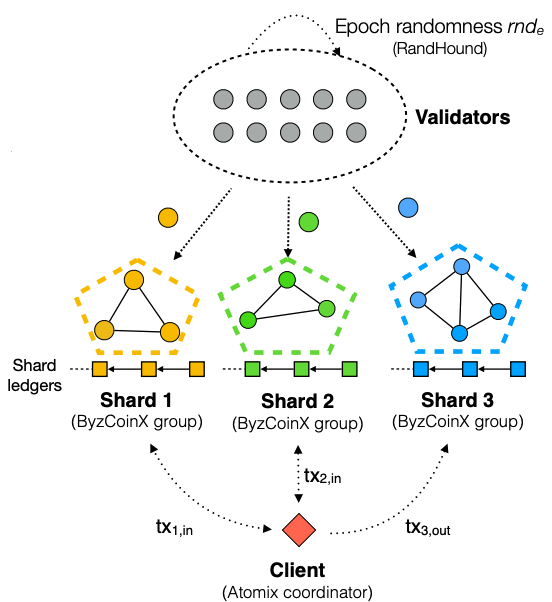
Decentralized Distributed Systems Laboratory
Decentralized Distributed Systems Laboratory
This page was last edited on 2024-03-20.
This page was last edited on 2024-03-20.